
By Thiago Machado
There’s a moment—usually around 2 PM on a July afternoon—when every Florida pool owner learns an important lesson about their decking choice. Maybe it’s when your daughter hops across the pavers like they’re made of lava. Or when your bare feet meet searing concrete and you perform an impromptu dance back to the grass. Perhaps it’s that first tropical storm when you discover your beautiful deck has become a slip-and-slide experiment you didn’t sign up for.
That moment? It’s expensive education.
I’ve watched too many families invest $80,000 in a stunning pool only to realize six months later that their deck is either scorching hot, dangerously slippery, or already showing cracks and stains. The pool is perfect. The decking is a problem they’ll curse every summer for the next decade.
Here’s what nobody tells you when you’re picking out materials: in Florida, your deck choice matters as much as your pool design. Maybe more. Because while your kids might use the pool three days a week, they’ll interact with that deck surface every single time they step outside. Your guests will form opinions based on how comfortable they feel walking around barefoot. Your home’s value will rise or fall partly on how well that surface ages under our relentless sun.
This isn’t about finding the “best” material—because that mythical option doesn’t exist. It’s about understanding the honest truth about each choice, what it’s actually like to live with, and which compromise fits your life in Lake Nona, Windermere, or Dr. Phillips.
The Five Materials Florida Homeowners Actually Choose
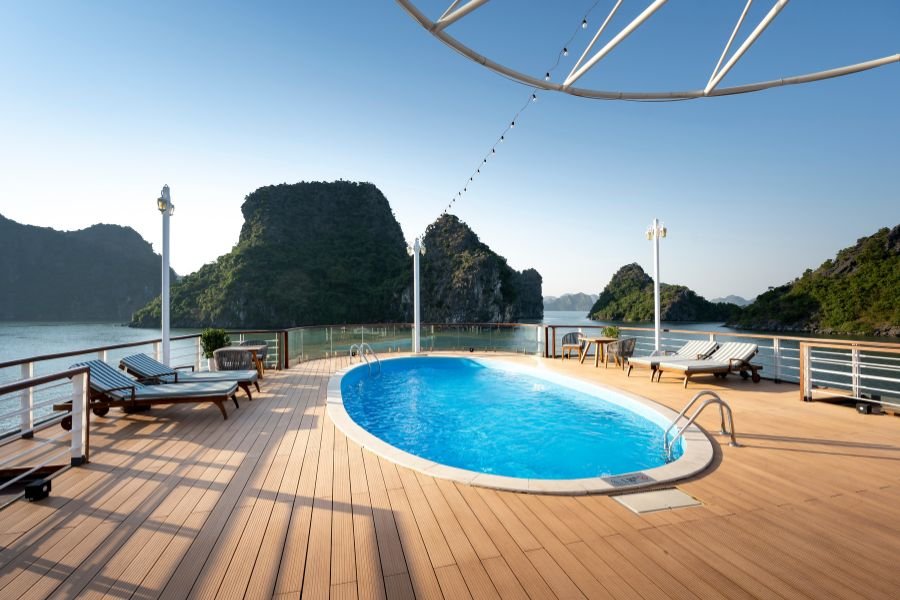
Walk through any upscale neighborhood from Winter Garden to Celebration and you’ll see five decking options dominating the landscape. Each has passionate advocates and bitter detractors. All have earned their place through different strengths.
Travertine pavers show up in the premium projects where homeowners prioritize comfort over cost. Natural stone brings elegance and—crucially—stays cooler than almost anything else. Stand on travertine at high noon and you’ll understand why luxury resorts choose it despite the premium price.
Concrete pavers represent the sweet spot for families who want durability, design flexibility, and manageable costs. They come in endless patterns and colors, handle Florida weather remarkably well, and—if installed correctly—last decades without major drama.
Poured concrete is the contractor’s default recommendation for good reason: it’s economical, straightforward, and gets the job done. But “getting the job done” and “creating the backyard you’ll love” aren’t always the same thing.
Natural stone options beyond travertine—bluestone, flagstone, sandstone—appeal to homeowners chasing that organic, timeless aesthetic. They’re beautiful. They’re also particular about maintenance and can be unpredictable in our climate.
Composite decking represents the new guard, promising low maintenance and consistent performance. The technology has improved dramatically, though it still carries a stigma among traditionalists who remember the early versions that warped and faded.
What "Heat Resistant" Actually Means in Central Florida
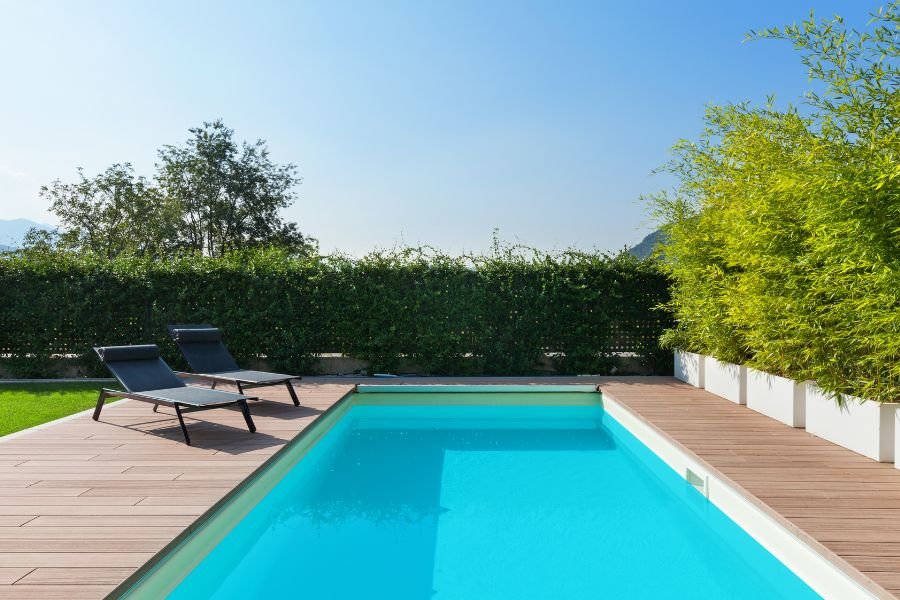
Let’s address the elephant in every Florida backyard: surface temperature in direct sunlight.
Marketing materials love phrases like “heat resistant” and “stays cool.” Here’s the reality—nothing stays cool under Florida’s summer sun except shade and water. The question isn’t whether a material heats up, but how hot it gets and how quickly it releases that heat.
Travertine earns its premium partly because its porous structure and light color reflect rather than absorb solar radiation. Touch travertine and concrete side-by-side at 2 PM and the difference is immediate and significant. We’re talking walkable versus painful. That translates to actual usability—kids can run around, adults can relax without shoes feeling welded to their feet.
Concrete pavers fall somewhere in the middle. Lighter colors help tremendously. Textured surfaces seem to feel slightly cooler than smooth, possibly because less of your foot contacts the material at once. But let’s be honest—dark concrete pavers in full sun will still test your threshold for discomfort.
Standard poured concrete? It turns into a griddle. There’s no diplomatic way to put this. Gray concrete in direct Florida sun becomes genuinely uncomfortable to walk on barefoot. You can mitigate this somewhat with lighter colors, but physics is physics.
Natural stone varies wildly. Bluestone tends toward the hotter end of the spectrum. Flagstone depends entirely on color and density. Sandstone often stays relatively comfortable but presents other challenges we’ll discuss.
Composite decking has improved its heat profile in recent years, but it still runs warmer than travertine or light pavers. The trade-off is maintenance—or rather, the lack thereof.
The practical solution most successful Florida pool areas employ? Strategic shade. Pergolas, shade sails, mature trees—these transform any material from uncomfortable to delightful. Even the hottest surface becomes manageable when it spends the brutal afternoon hours in shadow.
Slip Resistance: The Factor Nobody Thinks About Until Someone Falls
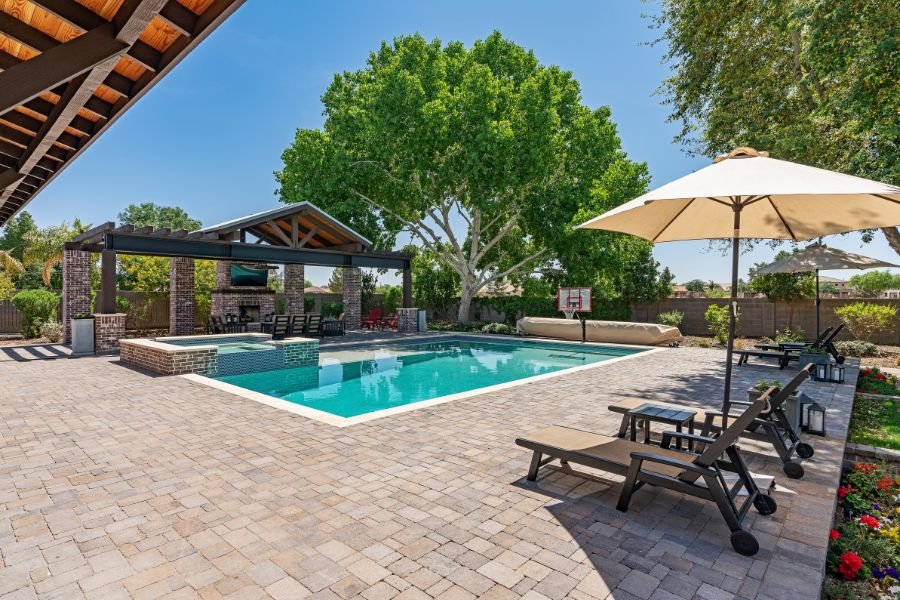
Every material is slippery when wet. That’s not a defect—that’s water on solid surfaces. The difference lies in degree and texture.
Travertine’s natural texture provides excellent traction even with a wet surface film. Its slight roughness works without being uncomfortable underfoot. This explains why high-end resorts and hotels consistently choose it for pool areas despite higher costs.
Concrete pavers can be manufactured with textured surfaces specifically designed for wet environments. Quality pavers incorporate slip-resistant finishes that work surprisingly well. But here’s the critical detail: not all pavers are created equal. Budget options often skimp on texture, prioritizing cost over safety.
Poured concrete presents the biggest variable. Smooth-troweled concrete becomes dangerously slippery when wet. But properly finished concrete with a broom texture or exposed aggregate provides reliable traction. The problem? Many contractors default to smooth finishes because they’re faster and cheaper. If you’re going with poured concrete, specifying the right finish isn’t optional—it’s essential.
Natural stone varies dramatically. Flagstone’s irregular surface generally provides good traction. Polished stone varieties become skating rinks when wet. Always specify a honed or textured finish for pool areas.
Composite materials usually incorporate texture in their design. Most modern composite decking products perform well in wet conditions. The issue tends to be consistency—quality varies significantly between manufacturers.
The honest assessment? Any of these materials can be safe if properly specified and installed. Any of them can be dangerous if shortcuts are taken. The question to ask your contractor isn’t “is this safe?” but rather “what specific slip-resistance measures are included in this material and finish?”
Maintenance Realities: What Your Weekends Will Actually Look Like
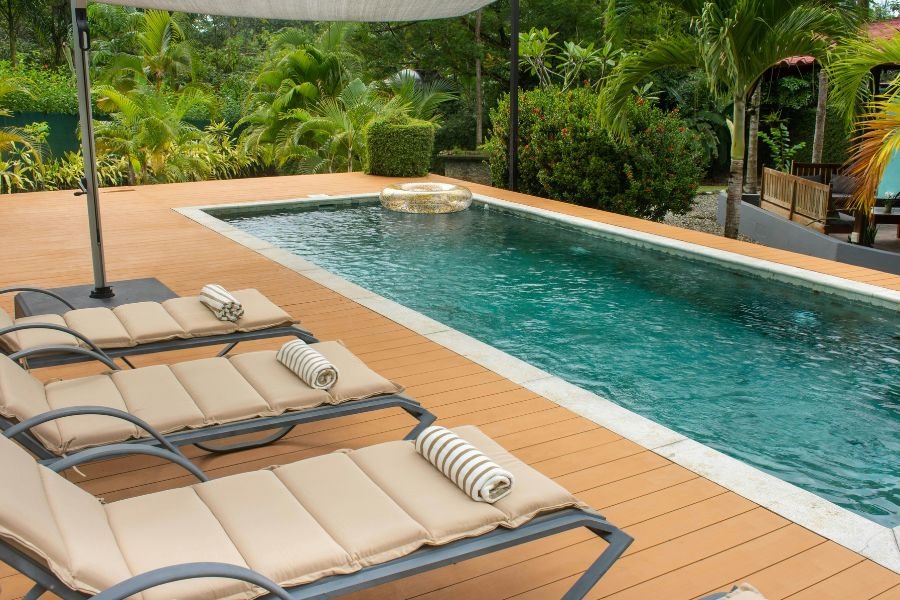
Maintenance discussions often devolve into extremes—either materials are described as “maintenance-free” (nothing is) or “high-maintenance nightmares” (rarely accurate). Let’s discuss what actually happens over time.
Travertine requires sealing every 2-3 years and occasional cleaning to prevent organic growth in its pores. This isn’t arduous—we’re talking an afternoon every few years and periodic power washing. The payoff is a surface that ages gracefully, developing character rather than looking worn. Stains rarely penetrate sealed travertine. Cracks are uncommon if properly installed.
Concrete pavers need less frequent sealing and handle Florida’s environment remarkably well. Individual damaged pavers can be replaced without affecting surrounding areas—a significant practical advantage. Pressure washing once or twice yearly keeps them looking fresh. Properly installed pavers rarely crack because they flex independently rather than as a monolithic slab.
Poured concrete tells a different story. Sealing helps with staining but won’t prevent the inevitable hairline cracks that develop in Florida’s shifting soils and temperature extremes. These cracks don’t necessarily compromise structural integrity, but they definitely compromise appearance. Resurfacing every 5-10 years becomes necessary if you care about aesthetics. Staining shows up more prominently and is harder to address than with pavers.
Natural stone maintenance depends entirely on the specific material. Softer stones like sandstone may need more frequent sealing and are more prone to surface degradation. Harder stones like bluestone are more forgiving but still require periodic care. All natural stone benefits from professional cleaning every few years to maintain its appearance.
Composite decking delivers on its low-maintenance promise better than skeptics admit. Occasional soap-and-water washing handles most issues. No sealing required. Individual boards can be replaced if damaged. The trade-off is that composite doesn’t age with the same character as natural materials—it tends to maintain its original appearance or fade uniformly rather than developing patina.
The maintenance winner? That depends entirely on your priorities. If minimal ongoing time investment matters most, composite wins. If you’re willing to invest periodic attention for superior aesthetics and feel, travertine or quality pavers edge ahead. Poured concrete sits at the high-maintenance end despite its low initial cost.
Aesthetics, Budget, and the Decisions That Actually Matter
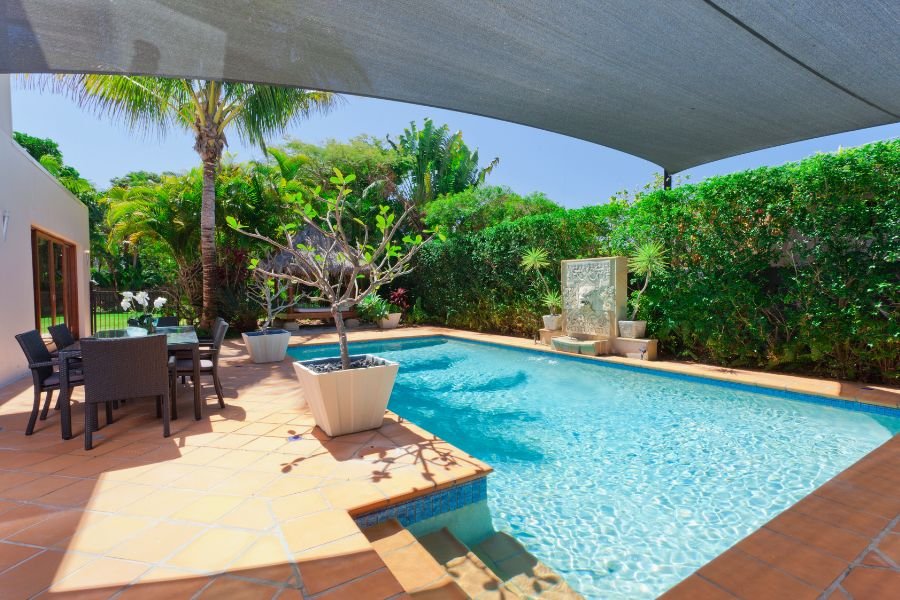
Cost conversations around pool decking typically start with square footage pricing: concrete at $8-12 per square foot, pavers at $15-25, travertine at $25-40. These numbers are technically accurate and practically useless.
Why? Because they ignore installation complexity, long-term value, and the reality that your deck directly affects your pool’s aesthetic impact and your home’s value.
A $40,000 pool with $8,000 of basic concrete decking creates a $48,000 investment. That same pool with $18,000 of beautiful pavers or travertine becomes a $58,000 investment. But here’s what the numbers don’t show: the concrete version might add $50,000 to your home’s value, while the upgraded version adds $80,000-100,000. The premium material doesn’t just look better—it repositions your entire outdoor space in potential buyers’ minds.
I’ve watched Lake Nona homeowners agonize over spending an extra $10,000 on travertine, then see their home appraise for $40,000 more than comparable properties with standard concrete. That’s not guaranteed—market conditions and overall home quality matter significantly—but premium materials consistently outperform in value addition.
Beyond resale, there’s the daily experience. You’ll interact with your deck surface hundreds of times more than most other home features. The difference between comfortable and uncomfortable, between a surface that stays beautiful and one that progressively disappoints—that affects your quality of life every single day.
Budget-conscious strategies exist that don’t require choosing the cheapest option. Using premium materials in high-visibility and high-traffic areas while going more economical in peripheral spaces creates visual impact without blowing the budget. Strategic design with less total square footage of exceptional material often outperforms sprawling expanses of mediocre choices.
The Florida-Specific Variables Nobody Mentions
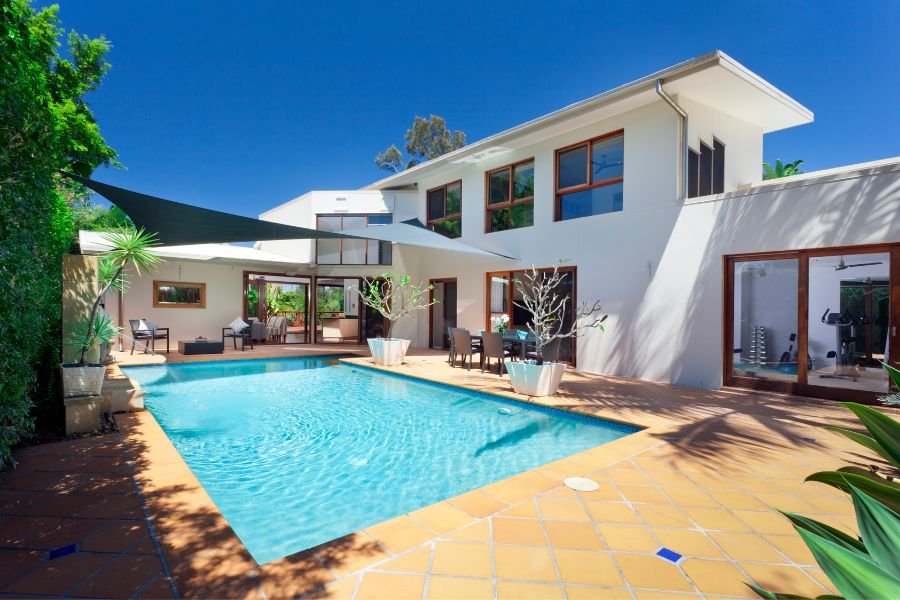
Our climate creates demands beyond simple heat and slip resistance. Tropical storms bring standing water and debris. Humidity encourages organic growth. Temperature swings—yes, even in Florida—cause expansion and contraction. Pool chemicals splash and track onto decking. All of this matters.
Travertine’s porosity, which helps with heat, also means it can harbor organic growth in humid conditions. Regular cleaning prevents this from becoming a problem, but it’s a consideration in heavily shaded areas or during Florida’s rainy season.
Concrete pavers handle drainage excellently if properly installed with adequate gaps and base preparation. The modular nature means water finds paths rather than pooling. But poor installation—and we see this far too often—creates low spots that collect water and accelerate wear.
Poured concrete’s tendency to crack becomes more pronounced in Florida than in stable climates. Our soil conditions, water table fluctuations, and occasional cold snaps (yes, they matter) all stress solid concrete slabs. Control joints help but don’t eliminate the issue.
Natural stone’s performance in Florida humidity varies. Some stones develop beautiful patinas. Others show water staining or organic growth that requires regular attention. Understanding your specific stone’s characteristics in our climate prevents surprises.
Composite materials have largely solved early issues with moisture and mildew in humid climates. Modern products resist organic growth well. But verify that your chosen product specifically addresses Florida’s environmental challenges—not all do.
The other Florida-specific factor: hurricane debris. Pavers and modular materials generally handle and recover from storm damage better than monolithic surfaces. A few damaged pavers can be replaced. A cracked concrete slab requires extensive repair.
Making Your Decision: The Questions That Actually Matter
How does this surface feel barefoot at 2 PM in July?
What happens when this gets wet?
What will this look like in five years with realistic maintenance?
How does this affect my home's position in the neighborhood?
What's my actual total budget, and how should I allocate it?
Who's installing this, and what's their track record?
The Honest Assessment Nobody Else Will Give You
If budget allows and comfort matters, travertine delivers an experience worth its premium in Florida’s climate. It feels right, ages well, and adds genuine value.
If you want proven durability with design flexibility at reasonable cost, quality concrete pavers from reputable manufacturers hit the sweet spot. They handle Florida weather excellently and offer flexibility basic concrete can’t match.
If you’re building a pool on a strict budget, recognize that poured concrete will serve its function but won’t elevate your space aesthetically. Budget accordingly for eventual resurfacing and accept the maintenance reality.
If you’re drawn to natural stone beyond travertine, work with professionals who specifically understand your chosen material’s behavior in Central Florida’s climate. Beautiful stones can become maintenance challenges without proper guidance.
If low maintenance tops your priority list and you can accept composite’s aesthetic trade-offs, modern composite decking delivers on its promises better than critics acknowledge.
The wrong answer? Choosing materials based solely on cost per square foot without considering the full picture—climate performance, maintenance realities, aesthetic impact, and long-term value. Your deck isn’t just a surface around your pool. It’s a significant component of your outdoor living environment and your home’s value proposition.
The right professional will help you navigate these trade-offs honestly, presenting options that work for your specific situation in Winter Park, Lake Nona, Celebration, or wherever you’re creating your backyard retreat. They’ll show you examples of each material in Florida conditions, discuss what maintenance actually means in practice, and help you understand how your choice integrates with your overall vision.
Your pool deck will outlast trends and serve your family for decades. Choose materials that work with Florida’s demands rather than fighting them, that fit your lifestyle rather than creating obligation, and that enhance your investment rather than undermining it. That’s how you create outdoor space you’ll actually enjoy rather than endure.
About the Author:
Thiago Machado is co-owner of Aqua Elite Pools, serving Central Florida families with custom pools that combine precision engineering and exceptional craftsmanship. With over a decade of experience in Florida’s construction sector, he’s built his reputation on transparency, accountability, and client-focused execution. Thiago believes outstanding pools should be visually stunning, structurally sound, and easy to maintain for decades—delivering both an excellent building experience and a finished result families genuinely love.